Friday, June 27, 2014

China blog part 2: Xiahe-Langmusi-Lanzhou


Saturday June 14, no-name Hotel, thought to be Langmusi Hotel, Langmusi

Early start, 4 hour plus bus ride, nek minute it's Langmusi at 3300m.We wind our way back to the main road down one valley and then along another to Hezuo, a big bustling city just like all the others, really, but once we leave there things thin out a bit. We're into really decent grasslands with not a tree in sight, big mountains and goats, sheep and yaks blocking the road every so often. Dramatic landscape. It's Sunday, and maybe that's a day off, because there are gatherings all over, with cars parked together - maybe horse racing? People seem to be dropped off in the middle of nowehere, but if you look carefully you'll see a little gathering or village in the distance. Nice.


There are a number of places we pass of some size, I wouldn't have thought much smaller than Langmusi. One of them we stop at for a while. Maybe Luqu? There appears to be no particular reason for a town being in that location - I wonder about the Chinese government wanting to settle the nomads, to urbanise them and thereby control them better? Perhaps the nomads themselves prefer a sedentary lifestyle? All of these towns have major construction with partly complete buildings on their main streets (which means two story blocks) and the first shops open are China mobile and China Post (the long arm of the party!?) Most of the Tibetans I've met, even though very poor, have a cellphone.


I am the only round-eye (again) and it's fascinating watching life go by you. There's a group of around 6 men and women who were in the bus station cafe at Xiahe and doing my trip. They laugh and carry on. Someone will say something and you'll get a murmer of agreement. Really nice kind of communal sharing.


The high, flat, grassland surrounded by hills changes quickly and there are some dramatic gorges up ahead. Langmusi, on the Sichuan border, is in this completely different kind of environment. And so we get to Langmusi (Lang-moo-sur) just before 12 and I spot the Black Tent Cafe so I know I am here. This cafe has a fabulous vibe, really nicely decorated Tibetan style and lots of long benches and comfortable seating with heaters underneath! Will be back here often!


Langmusi is more like what I expected Xiahe to be - small and on hills and valleys. It's got a nice vibe, but here too is plenty of construction. Place is empty of tourists, the gompas are mostly shut and it's just how I like it! First up is Kerti Gompa, on the Sichuan side. There's several buildings here, built in 1413 and home to around 700 monks. I walk around and move some prayer wheels and then climb up a short pathway (huffing and puffing) to get some excellent views across the valley.


Sunday June 15, no-name Hotel, thought to be Langmusi Hotel, Langmusi

Weather is looking good, so I decide to do the Namo Gorge walk. Touted by LP: "a superlative...hike. The gorge contains several sacred grottoes...cross rickety bridges flung over the gushing stream, trek past piles of mani stones and prayer flags and hike on into a splendid ravine. After about 30 minutes of clambering over rocks you reach a grassy plain surrounded by towering peaks." I really think that needs rewriting, the stream was bubbling more than it was gushing, the bridges where bits of wood sitting on the stones, the ravine was OK, nothing special, the grassy plain was enclosed by decent hills. Anyways, I really enjoyed the walk in, especially having peace and quiet and space to think. I even took a selfie!


There's plenty of people to meet on the way. I try and say hello to everyone I make eye contact with. I meet a group of Tibetan teens who live about an hour away. One guy has good english so we strike up a conversation - this is his 4th time to Namo, he learned english at school and could he take a photo? Yes, of course, and I get some nice shots of him and I. A large group assembles around us, and they all pull out their cellphones, i-pads and cameras and shoot away as well (I get a shot of this just at the end - hilarious). They're all wired up, but still inquisitive about who I am and where I'm from. I wonder how much the Chinese version of google lets them explore their world?


I also meet a couple of Israeli guys who think they are lost. They pull out a map but I can't really help them. I'm really unsure where they've come from (I think a loop up the right past the Kerti Gompa). They've been travelling through China for 2 months, with 2 more to go.


I give myelf some time just to sit and listen. Until then I hadn't heard the birds, and I could make out at least 5 different calls. I sense the stillness, the quiet and also the noise in that quiet. I'm sitting on my contemplation rock and then a few things happen at once: some big calling out and yahooing, rain and I have a sore bum. Clearly time to get going.


Coming back out, maybe things looked a little more impressive?! Somone has drawn a heart and written love inside it with small stones (did not notice this on the way up). Maybe the peaks are a little more towering and the ravine a bit more looming. It certainly would be if the river was bigger, but it's just a piddly little stream that only seems to start halfway down, like appearing from nowhere. Apparently this is the start of the Yellow River, hence the hoo ha with flags and stuff. Also one of the caves has given Langmusi its name.


Lunch (aka hiding from the rain, I don't normally do lunch when I travel) is at a Tibetan Restaurant. First thing, I miss the entrance and start going up stairs to the bedrooms. Then, when I go through the blanket that is a door, I'm met by what looks like a family lounge and open dining area. I've gatecrashed a family gathering! There are 5 kids in monk's robes, husband (who petty much comes and sits with me straight away) and wife (who brings the menus and does all the cooking). Much awkward enjoyment on both sides I'd say. I order tsampa (spelt tsamba in their menu, I assume the same) and some yoghurt. They pour me a glass of hot water as well. The water was good, the tsampa, some kind of porridge, is very very awful, the yoghurt is really nice. Have to say that all the Tibetan food I've tried, with very few exceptions (Tibetan bread in Darjeeling springs to mind), is not much chop. Limited palette of flavours, I guess, and some completely different tastebuds, trained through the ages to like things that are hard to like!


There is awkwardness and interest as well. One of the kids is very keen to see my writing in the red book. I guess so different, I'd be the same.


The weather clears and so I decide to go up to the Serti Gompa, although the ticket calls it the Langmu Monastery. It was established in 1748. My ticket tells us that this area has a "distinguished natural langscape [nice] and is well known as Oriental Swiss, it is listed as one of the top 20 National Charming Towns, national AAAA famous sceneries." I guess in winter it would all be covered in snow and would look stunning!


This place was amazing, a highlight. The views and the atmosphere were just perfect. A very peaceful place, better of course for having hardly anyone else there. The architecture of the buildings very distinctive - the Chinese curves, the sloped walls and windows, the same kind of iconography that I saw at Labrang. What's special here is the gold and silver roofing, which is incredible, and the setting, which is stunning. I'm allowed to photograph the vestibule of the main meditation hall, which is quite similar to what is inside, so that was cool. The colours of choice on the inside are orange, blue and green. Outside it's monk-habit red, yellow and brown. There is some distinctive patterning with dots and furry space (this is hard to describe!) and the usual array of maitreyas - past, present and future, lamas then and now reincarnated, bodhisattvas, uncle tom cobbley and all. It's quite a procession. Some of the painting on the outsides is very fine. I love these kinds of places and I don't mind spending a whole lot of time here. The beauty of being on your own is that you can do this without worrying what someone else might want to do (and Mary is very, very patient). I just like hanging out, taking in the space, I could have sat a long time in that meditation hall... (well, I did).


Walking around, I can hear the quiet throat-chanting from inside buildings. There are some kids playing with battery cars and a few other tourists, the wind is whistling just a little and I feel very very peaceful and calm.


Monday June 16, Lanzhou Hualian Hotel, Lanzhou

Today a long trip from Langmusi via Hezuo to Lanzhou, from 5 degrees to 30 degrees. Begin with 4 layers and end with 1! I am a well-oiled travelling machine, and my guts and head are feeling better today, so that's good. The sun is out, its crisp and clear and I've had a great week in eastern Tibet, with the Amdo Tibetans.


The bus is pretty empty as we re-trace our steps back over the grassland plains and hills, before descending to Hezuo. There is some snow on the peaks, the sun is out, and it's a crisp and sparkly day up here where the air is thinner. On the way down, the yaks are just getting busy, not yet blocking the roads, the kids are setting off to school (at 6.30), the fires are starting up and the hills are green in the sun. No trees, just folds of land, valleys with little villages of brown, the ones closer to the road often having a conservatory with glass to trap heat. Pass a small temple with prayer wheels quite isolated, with about 8 women prostrating themselves in front of it - this would be 7.30am.


We get to Hezuo and the minute I'm off the bus I'm onto another bound for Lanzhou. It's packed, there's room for one (me!) right up the back seat. LOTS of stares and smiles. The road's busy, the traffic slow, and the buses are the fastest thing going, except for the occasional car. From Hezuo we head due east. Things are getting warmer. We stop at a place at 10.30 that connects us with the main drag into Lanzhou and have 30 minutes for Muslim beef noodles. When the dishes are ready a shout goes up from the kitchen 'hay'. It's a real scene and Lanzhou is famous for these beef noodles which are, apparently, spicy hot, Most people don't have some, but some do! It's a bit pointless but nice to stretch the legs.


Back on the road, we've got 144km to Lanzhou and it's all on motoway, increasingly through absolutely barren hills and mountains with green valleys (I'm guessing from the snow melt). It's the badlands of China, complete rainshadow, with deeply eroded mountains with layers of white/brown sandstone/gravels and red stones in lots of layers. Kind of back in Cappadocia without the plateau thing going on.

China blog Part 1: Lanzhou-Xiahe


Mary's working for 3 weeks and I'm on holiday, so it's a chance to travel the silk road, or roads, which basically connected Europe and India with the east (China in particular) from 500 BC to 1500 AD give or take. Mary and I have had a week in Xian, the ancient capital of China and the start/finish of the road(s). This trip on my own picks up the route from Lanzhou and goes westwards, into the desert. I'm a bit nervous about travelling on my own, but excited as well, and I try to keep in mind that "China is a learning experience, not an escape; an adventure, not a getaway; a new challenge, not…a holiday" [J.D. Brown, 50 Memorable Trips]. Most of this was written on the trip but posted retrospectively since decent bandwith was very hard to find to upload. Enjoy!


Sunday, 8th June in Hulian Hotel, Lanzhou

And we're off. Midnight flight from Singers and into chinese airports we go. Really good signage (this is important!) Lots of black-clothed kids in police uniforms. We got herded into a pen at one point for 'explosion training'. Funny being in China again. The people are more aggressive you can see it and feel it. One woman tough as nails on the plane fights to get her place in the queue, tells me to get out of her seat, pokes and prods me (she was right, I was wrong). On the other hand the Chinese appear to me to be so much more confident and assertive than Singaporeans. I'm impressed with how the people get on with each other. There's lots of casual conversations between strangers, lots of laughter (sometimes raucous!) and people clearly enjoying themselves and each other. It's such a contrast and I like it.


In Lanzhou (Larn-joe) I work my way out of the airport and just kind of stumble into the airport bus rather than a taxi. Went fine, although I didn't really have a clue where they dropped me off, just had to ask and work it out (in the end, probably a 2km walk down the main drag Tianshui Nanlu. So yes, I am in Lanzhou, capital of Gansu Province, gateway to the Hexi ('Hersh') corridor and the silk roads of the desert. It was an amazing landscape coming in - large hills of sand like giant tailings, dirty and dusty. In the valleys some green but I couldn't see a river. LOTS of big infrastructure projects - motoways, giant flyovers for two train tracks and, around the airport where we landed 70km away, lots of incomplete towers of apartments.


Lanzhou is (I think was is more accurate) the world's most air-polluted city on earth. It's on the Yellow River and in between two mountain chains. Recent Wikitravel comments call it busy, ugly, polluted & expensive with insurance scams and  foreigners prices, suggesting you'd be a masochist to stay a few days! Well, I've got 4 nights here at various points in this trip! You notice the typical features of Asian - and some specific to China - cities. The constant construction, the big tall and modern, the big tall and ugly, and then the older buildings which are ramshackle constructions with the signage almost as tall as the space. In there will be someone selling drinks and snacks, and there being nothing differentiating him/her from any number of others doing the same thing. As always, people are living their lives on the street - lots of informal fruit sellers (berries!) and girls in restaurants looking bored dressed up in their red dresses trying to lure the customers in.


Monday June 9th, Hulian Hotel, Lanzhou

Planning day today - organise trip south to eastern Tibet for a week, find some food, change some money, buy a train ticket. How hard can that be? (Answer: yes, quite hard). First up the travel agency in the hotel: the Gan Su Hualian Triavel Service and it's reassuring cos their travel tenet is "the at home and affection family love services" and the "integrity, innovation" is the management idea. Yes. Half an hour later I'm walking out of there and I'm sure they still had no idea what I wanted to do! Another place that spoke english made it a 5 minute jobby


It took 3 hours to find a place to change money. I went to the Lanzhou Bank, the Bank of China (1), The Agricultural Bank, The Bank of Communications (1), the Construction Bank of China, the Bank of China (2), then the Bank of Communications (2) and finally the Bank of China (3), where I had to wait for about 30 minutes. Oh yes. Then down to the train station to get the ticket. I had an agent write out the destination in Chinese. Apart from telling you where the ticket office was, there is no signage at all in english, so you have no idea which counter to go to and I would have had no chance of getting this ticket without it written down. The woman at the counter is dismissive, says no to my passport, snatches my money then asks for the passport which she grabs from me as well. Did I do something wrong?


Tuesday June 10th, Overseas Tibetan Hotel, Xiahe

So, onwards and southwards. I'm on a local tour to Binglinsi after which I will leave them and carry on to Linxia and then, hopefully, Xiahe. Lanzhou is built around the Yellow River (Huang Ho) and it's big, dirty and swollen. I'm shown the 100 year old bridge the Germans built (apparently a corrupt government raided the treasury to pay for it). My companions are university students ('management' but not business) at Lanzhou University. They have been married 5 years. She calls me 'Professor' after my attempts to explain what I did. The guide (Pingling Soeur) is a trick, a lovely woman, yells at the top of her voice and just enjoys life.


We drive along the Huang Ho for a while, past some big energy installations, giant chimneys belching smoke into the air, a recurring image of this city. So we get to the reservoir, actually a huge lake with a hydro dam and wait for our boat. About an hour and 20 mins! We have to wait for a certain number of people to arrive to make up the complement for our speedboat rather than taking the ferry.


Binglinsi, a bastardised Chinese word to do with a thousand buddhas, was spectacular. More than expected. The boat trip on the lake was pretty nothing until we gradually got into some spectacular sandstone formations, heavily eroded. These were the canyons (Dasi Gou, Big Temple Gully) within which the Buddhist community built niches, monks quarters and a giant buddha. The landsape itself was pretty amazing. I loved it, all the better when unexpected.


There are around 180 caves, and although the first ones were here built around 500AD, they had their heyday in the Tang Dynasty, most from 960AD. The caves have a range of clay figures and paintings. The big statue of Maitreya, the future buddha, is cool, but so are some of the other statues. Because of the local materials being so soft, the statues were constructed of mud and straw over inner wooden frames.The landscape just adds to it all.


The reservoir is just outside Liujiaxia and they drop me off there to catch a bus to Linxia. So far so good. The threatened highway from Liujiaxia to Linxia has now been built and instead of a 3 hour journey it is less than an hour. It goes over several impressive bridges (visible from the lake - arch and suspension), and skirts the lake before cutting into a valley. Anyway, I get the idea in my head that I could actually get to Xiahe which is only another 2 hours. This is achieved via a really long story that involves complete misunderstanding and a totally gratuitous act of kindness from some locals! I am really struggling with the language - the tonal range is incredible, the pronounciations far from the sounds that I am used to hearing, and (it seems to me) to be a language very limited with its range of consonants. Lesson learned: make sure you write down the name and, if possible, show the characters from the guide as well. Shame there isn't a map with english/chinese names.


Linxia was once known as "Little Mecca" and had 20 mosques (many destroyed in the Cultural Revolution). LP reckons Linxia is where Han China finally runs out of steam!. Certainly feels that way and once, finally, I am on the bus to Xiahe and we slowly climb up the large valleys, it's pretty clear we are crossing cultural boundaries and getting more Moslem and Tibetan and less Chinese


Anyways, from Linxia to Xiahe was one giant causeway through a valley surrounded by huge mountains, like going from Opotiki to Gisborne but the valleys are twice as wide and the mountains are twice (four times?) as tall. The motorway is basically built over the river, with big supporting pillars. Very impressive, as are the tunnels that just plough through the mountains. This is completely separate to the road that we are on, which also has its own bridges and tunnels! I liked the sheep and goats on the roads, blocking all the beeping traffic! Also lots of mosques and different architectural styles, with Tibetan and Arabic script (and sometimes English) popping up in the signage.


Xiahe comes up much more suddenly than I was expecting and it's a lot different. I somehow thought it was a one-street town on a ridge with run-down, funky cafes like Pammukkale. How wrong, how wrong. For a long time, I think I'm in the wrong town! No names to say Xiahe, no hotel names in English. Hmmm... Then I see some other western travellers, looking as lost as I am, and pretty soon after I see the place I'm looking for. It's much more modern, cleaner and bigger than I was expecting but looking good I think. Lots of modern blocks of shops in the bottom and restaurants or hotels above. I'm really pleased to be here. It felt like today was the first real day of discovery and exploration - like places I actually want to go to rather than places I have to go to get there - and it's been a real buzz.


Wednesday June 11, Tibetan Overseas Hotel, Xiahe

So I am now, as I am repeatedly told, in eastern Tibet, not Gansu province. The woman manager at the hotel is a trick. Not bad english, singing away to herself, and very efficient and sorted.


Interesting watching monks in traditional costume riding around in audis! The place is booming with 'construction' everywhere. There's clearly been a pretty recent make-over Chinese style, with rows and rows of shops all in uniform buildings and signage. Saw this is Linxia as well. Guess the developers have moved in. Walk away from the main drag and we are back to pretty traditional, scummy low rise that's probably been here for hundreds of years (or variations thereof). I am definitely out of my own world here. The people are dressed in a mixture of local and semi-western attire, many of them have all kinds of face masks on (not just the women, but mostly) There are black-dresses, black shawls and many other different kinds of traditional dress that I guess denotes all kinds of things if you are from these parts but which just adds up to colourful if you're not.


I'm enjoying the cold (we're 2920m up)! Beanie, t-shirt, collar shirt, long-sleeved shirt and jacket all on at once and I am not warm! The warmest part of this town is my bedroom - none of the cafes or restaurants are heated (1 exception: Nirvana, aptly named!)


This place exists mostly because of the Labrang monastery, a huge complex of buildings established in 1709. The Tibetans regard this area as part of Tibet, although outside the 'Autonomous region of Tibet' (apparently 60% of Tibetans live outside this area). Labrang is said to be the pre-eminent place for study of Tibetan Buddhism, more so than in Tibet, where there was considerably more damage done during the Cultural Revolution of the late 1960s.


The kora is a 3km devotional walk around the monastery with rows of prayer wheels and worship spots. From a cafe I see a group  of women doing the kora. They come to a spot and do around 20 of these: stand, arms raised fully above head with hands together in prayer, hands together against chest, on knees, forward, head down, fully prostrate, then back up again. I walk the kora. You get drawn into it - turning the wheels, finding the ones that have stopped and getting them going again, pushing even harder the ones that are turning fast. At the starts and finishes of the long halls there are small chapels with large wheels and bells and they are great as well. I want to just hear the bell sound clear and quiet, but this is often interrupted by the stream of pilgrims coming through, ready or not.


I climb to the thangka display terrace on a hill across the river from the town where I sit and contemplate the meaning of life. This place is the scene of the unfurling of a giant 20m x 30m thangka during the Monlam (Great Prayer) Festival. I'm really short of breath and only slowly realise that it might be altitude.


Thursday June 12, Tibetan Overseas Hotel, Xiahe

That's what happens when you have time, isn't it? You replay the tapes - the family stuff, the music, the 'what am I doing in this place' and so on and so on. The mind just never stops. How to calm it down, how do you do that?


So the main job of the day is to visit the monastery and take the tour to look at the different temples and halls. They were amazing, impressive. Giant statues (apparently the vast majority made in the 1980s because the originals had all been destroyed), giant shelves stretching to the roof full of scriptures (over 65,000 volumes in sutra boxes), thankas on the walls, bells and throat-chanting, carpets - it's sensory overload! The place is full of monks (around 2000) and pilgrims - even the Chinese tour groups are conspicuous and me, well I'm the only round-eye around in thousands! This is religion for real, not for show. As one guide put it, these are "the lived realities of Tibetan Buddhism - books and so on do not cut it; Go see a real place with real people." Our guide said that if I wanted, I could spend a couple of years here learning and being a monk


When the tour has finished I find a deserted temple to sit and write, and a dude in his 20s comes and sits right next to me. An interesting cultural moment. He hardly acknowledges me, but there he is, right there (he had been doing a circuit of the building). I make some attempts to say hello, but he hardly acknowledges anything (just a grunt!). I show him my diary so he can see what I'm writing, I write my name down and ask him to do the same, I say hello, all the things. His eyes are interested, but the voice just grunts! From the bottom up, he's got basketball-themed sneakers, blue jeans and a black shirt, with a large grey shawl that comes over his shoulders and down to his knees. There's a bright pink sash keeping it all intact at the waist, a cricket-style grey hat with a floppy brim and some prayer beads. He sits next to me but look straight ahead. I guess he's there for 5 minutes and then he's off, no acknowledgement or farewell, just off to continue walking around the temple. He's got a friend who's arrived (maybe he was just waiting?) who walks round with him shouting into his phone for at least 2 laps. I count the laps and I'm getting to 17 (about 1.15 minutes to do one!). Very intriguing.


All the while there's been another devotee (not a monk), and this is unusual, doing the full prostration thingy that I described yesterday. He goes through this many times (I'm guessing for 30 minutes that I have been here), then quietly washes his hands, packs his things up into a little bag, and walks off. There's also some snotty-nosed kids who want to say hello and touch my things. I smile sweetly but like all kids they have no sense of when enough is enough. I try and make myself as boring as possible and it works most of the time.


I go back to the huge prayer hall (it would seat 1000 monks for chanting etc) and sit on the stairs outside, get out my little red book (how appropriate in China!) and start writing. Before long, there is a little gathering of monks who have just come out of a chanting session at about mid-day. They can't help themselves - who am I, where am I from, what is my name and so on. It's a mix of kids and older monks who are there with a watchful eye I think. The dude I connect with is Awang Jianzan, who was able to write his name for me. We pose for a photo together. It's a nice moment. He's got a friend as well who's name is (sounds like) See-rup (he writes it in characters). There's a cute kid, who's 12 years old, who's name is (sounds like) 'Jeromytasi'. They're all kind of playfully jostling with each other. It's a nice moment. The monks are interested in the camera - at least one of them knows exactly how to work it.


I then walk up and around the hall a few times, mostly to catch the throat-chanting going on inside. Previously we had been shooed out of a temple where they were going to do this, so it was a bit of a treat, even if it was from outside. There's a drum going as well. Previously we overheard some young monks yelling their heads off chanting!


Friday June 13, Tibetan Overseas Hotel, Xiahe

So it's my last day in Xiahe. Driver picks me up and off to the Sangke grasslands, which really were pretty underwhelming, although I guess in an economic sense this is what makes life in an extreme environment possible - grass in summer for herds of yaks. But no yaks here, only horses. Tibetan culture has been - monasteries notwithstanding - nomadic, given the extreme cold and unhospitable terrain. I'm the only tourist in the whole place, bar none. This is around 10am. 


Not a lot of sophistication with the tourism here. The yurts (round tents) have been replaced by permanent structures with very little attractive about them but I guess the dear Chinese tourists won't get too cold or smoked out. Nothing authentic going on really. The 'yurts' are in complexes with the odd animal and a big gateway structure at the entrance. None are occupied and there must be over a hundred. Very very tacky! Best moment by far was coming back past a group of locals playing a board game that looked really interesting! I'd seen them on the way up, but this time I cross the road and then just hang and smile. I get invited to join the game (and throw my money away?!) and there's lots of friendly smiles.


Saturday, July 6, 2013

Urgent Report - Latest on D & M's Real Busy Day


 Beach - Pamucak Beach, reached by dolmus (large passenger van). Long stretch of sand,  swimmers. Main achievement: walking along one stretch, looking at some random boats, walking back. Lunch - at Pamucak Beach. Main achievement: 2 plates chips, beer, lemonade. Drinks - back at the ranch. Main achievement: beer, wine, sunset. Dinner - out. Main achievement: spicy lentil soup, grilled eggplant in yoghurt, chickpea salad, stuffed mushrooms with cheese, stuffed eggplant, brown beans, plump grilled chicken, baclava, honey-dew melon, beer, wine, stork photos..

 Today is market day, the first one we've managed to time correctly. Photo ops and then some more crusiy time wandering, gathering energy for our 4 hour bus trip tomorrow. Playing heavily on our minds is trying to find an apartment - we've had several deals fall through. Basically when we return we have to move and, now not much more than 1 week out, there's nothing to go to! Breakfast each day consist of emails and phone calls and research on where we might live. It's been a thing....

Storks, Travel Advice & How to Do Nothing and Enjoy It


 There's quite a lot to see in Selcuk, but it doesn't take too long to see it. Ephesus Museum, with much of the spectacular 'art' taken from the ancient city, is closed for 6 months, timed perfectly for the tourist season.

 Instead, we go stork hunting. Over the course of the day, we learn that the town builds large metal bases on the tops of ancient columns and the Roman aqueduct for the birds to build their nests. Hatching occurs in March and so right now the nests are full of nearly fully-grown birds. Quite impressive. The birds are often tagged and we are told get injections for their good health. When the nests get cramped, the male is told to leave. Nothing new there. Obviously we look like keen bird watchers - one hotel owner invites us up to the terrace, where Mary takes her special photo (see below).

 Many many photos later, it's into town for a walk around the aqueduct and find a money machine and have some lunch. All duly achieved.

 Whilst having lunch, we meet a couple of Pennsylvania, fresh off the bus from Greece and looking more than a little unsure of where to next. We talking to Tim and his wonderful partner beginning with 'A' and (David thinks) ending in 'ine'. Funny thing is, we spent hours chatting with these guys in several places and only introduced ourselves when we said goodnight and goodbye! We help them plan their travel - they are moving fast, covering many of the places we have been but in less than a week. T is a teacher but has been doing some voluntary work for non-profit groups in Calcutta and Cambodia recently. A works with the deaf in the US as an interpreter/teacher. .

 We also meet a German/Australian couple running a travel agency in town and chat with them for a while. They've got lots of good advice and hook us up with someone in Istanbul who may be able to get us into an 'authentic' dervish performance and maybe find a real saz shop. Just nice to talk to people about random things, really, and feeling like you have nothing in particular to do than what you are doing right now.

 While T and A go to Ephesus, we clean up the sights around town - St John's Basilica and the hilltop castle, Isa Bey Mosque and the Artemis Temple (once one of the 7 wonders of the world, now reduced to a single column. That's history for ya!)

Today is gonna be real busy, it's stressing us out thinking about it: 1. Beach. 2. lunch. 3. Drinks. 4. Dinner This travel is hard work, eh?

And while we have all of this wonderful, luxurious time to play with, we both consider the delights of slow travel: -Spending 45 minutes talking about the restaurant trade with Mustafa -Spending 5 hours in ruined cities with the birds for company when really it could have been easily done in half the time -Doing nothing but read a book in Egidir and eat a Magnum on a terrace beside a lake as big as Taupo -Discovering the mysteries and delights of double-knot vool-on-vool village carpets -Taking a day to walk 10-14km along a canyon valley shaded by trees and with a stream running alongside, most of it completely alone -Going back to the same places, where you are recognised and greeted like long lost friends. Seeing places in different kinds of light and shade. -Sitting and watching people go about their business but having no business of your own! -And much much more!


Selcuk


And so to Selcuk, for 4 nights. We are going to slow the train down even more with a 4 day stay. We're at the Australia New Zealand Guesthouse, a well known backpackers place with friendly owners and a rambling set of rooms and terraces over 3-4 levels. We've got the 'honeymoon suite' with 'jacuzzi' (it's a bit bigger with a bath) for about 50 bucks a night. Good value for Turkey and a great place to chill.

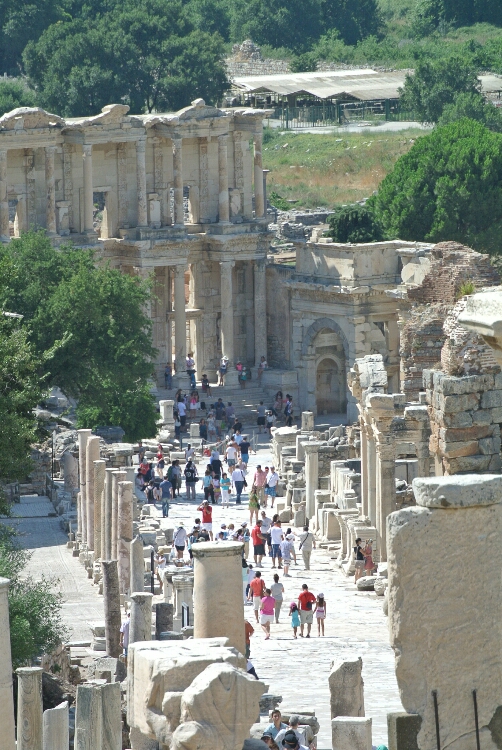
 After a cruise through town to book tickets and eat eggplant, we're off to the ruins of Ephesus, along with every other tourist in this part of the world. This is Turkey's biggest tourist attraction other than Sultanahmet in Istanbul. The library and terrace houses are amazing, but overall we are a little unimpressed after seeing Aphrodisias. Perhaps the crowds, maybe the unsympathetic restorations in some places, maybe we've just been a bit spoiled. However, still good to do.


Tuesday, July 2, 2013

Aphrodisias


Our planned trip nearly didn't happen. They needed 5, we were only 2, so we chartered the whole vehicle and offered free trips to anyone we could find (not many, if any, tourists in town. The lucky winners were 2 South Korean kids who had just got off a 9 hour bus-ride from Goreme and were considering eating something when David came a-calling!)

 So, at triple the price, we go to the best ruined city Mary has seen in this hemisphere. Really hard to get to, but well worth it. Superb theatre and stadium and some amazing gateways that easily rival Ephesus, which is much better known. Again, hardly anyone else around. In its heyday the city was famous for its sculpture school and exported pieces all over the Roman empire. The museum was packed full of impressive pieces.

 The last week has been a series of 2-night stands. We now head for Selcuk for 4 nights, then a little fishing village near the island of lesbians and then its back to Istanbul for a couple of nights and we're home.


Pamukkale


And so the the white terraces of Pamukkale. Stunningly beautiful, like nothing you've seen. Shoes must be removed, and so we walk barefoot across white calcite formations with water running down. Every so often a pool of water. David was here 25 years ago when this was a sealed road and he stayed in a hotel at the top. Since gaining World Heritage status, all the hotels have been removed and the road integrated back into the natural pool system. As best I understand it, springs at the top of the hill lose their carbon dioxide as they flow downhill, leaving deposits of white calcium carbonate, which builds up in steps. In the late afternoon sun, the deposits and pools are spectacular! 

And to top it off, so to speak, there is a substantial ruined Roman city of Hierapolis. We spend a couple of hours looking around - especially at the large restored theatre (impressive) and an isolated Martyrion of St Philip with 8 arches and crosses high up above the city. We've just about got it all to ourselves. Wonderful day.